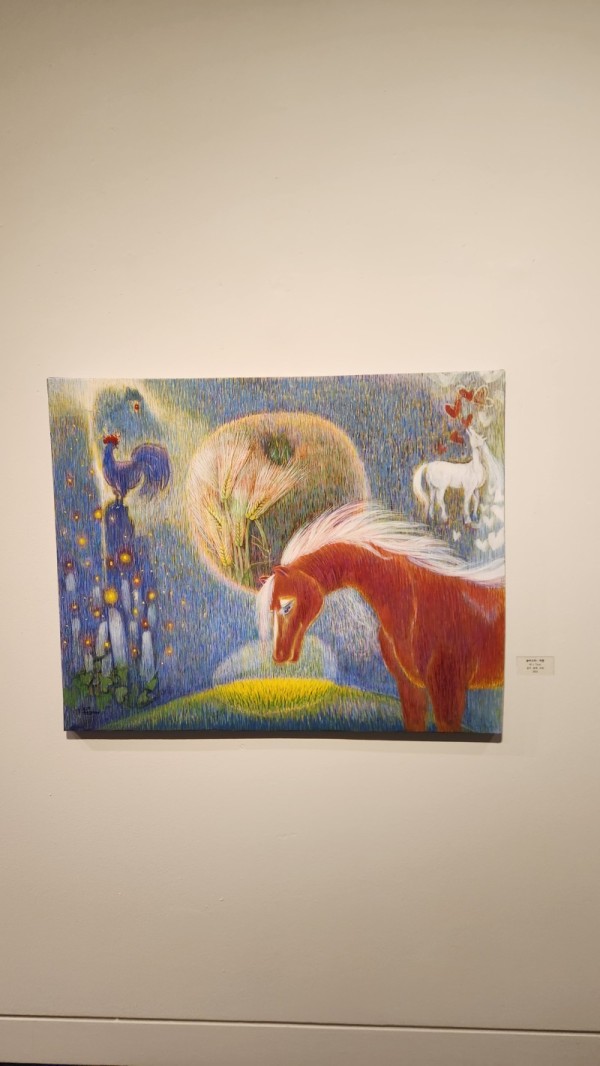
The solo exhibition of artist Mi-hee Kim is currently being held at the Insa Art Center (41-1 Insadong-gil, 2nd Floor) from the 11th and will continue until the 23rd.
Having reinterpreted the traditions of Korean painting for over 40 years since her debut at the 1984 World of Art exhibition, Kim defines her artistic journey as a "long quest for history and self." Through her unique "fermentation of color" technique and the theme of Sumbi-sori—capturing the vital energy of Jeju’s Haenyeo (female divers)—she offers warm consolation to modern society.
Kim’s early work is deeply intertwined with the dynamic flow of modern Korean history.
From the late 1980s to the early 90s, she captured the era of grassroots democratization movements, filling her canvases with symbolic images of candles and crowds.
Reflecting on that time, she describes living a "double life," balancing roles as an educator, painter, and mother. "I went through a period of expressing myself passively from behind a wall, unable to participate actively in reality," she recalled.
However, she explained that this "outsider’s perspective" eventually became a strength, allowing her to observe society with objectivity. Witnessing profound social tragedies like the Sewol Ferry and Itaewon disasters further strengthened her resolve to focus on the healing power of art.
Sumbi-sori: Life Energy Bursting from the Border of Life and Death
The core keyword of her work is Sumbi-sori.
This refers to the sharp, whistling breath (Hui-yu~) a Haenyeo diver exhales when she surfaces after holding her breath underwater to the point of collapse.
Kim vividly remembers the moment she first heard this sound while waiting in line at a restaurant during a trip to Jeju: "The sound sent shivers down my spine; it was an instant, overwhelming inspiration." To her, this breath is more than a physiological phenomenon; it is a wave of resilience from women who endured the harsh sea to support their families.
To transform this intangible sound into visual energy, Kim replaced the Tewak (the life-sustaining buoy used by Haenyeo) with the image of a red apple. By layering waves of life energy onto the golden curves of Jeju’s Oreums (volcanic cones), she works to soothe the emotional callouses and scars of modern people.
Kim names her signature technique the "Aesthetics of Fermented Color." This involves layering natural pigments and animal glue onto thick Jangji (traditional Korean paper) made by bonding two to five layers of mulberry paper.
She likens this process to the fermentation of Doenjang (soybean paste) or Kimchi, which develops deep flavors over time. "When various pigments harmonize and pile up, the desired color finally emerges," she explained.
This creates a "well-aged history and time" on the canvas, distinct from Western acrylics or oils.

Notably, she omits shadows and three-dimensional shading to capture the spiritual essence and "Qi" (energy) of the subject rather than its mere appearance—a modern succession of traditional Eastern values akin to Leonardo da Vinci’s Sfumato technique, which adds mystery through blurred boundaries.
The Value of ‘Aura’ in the Age of AI
Regarding the rise of Artificial Intelligence in art, Kim holds a firm stance.
While AI can replicate forms or create prints, she believes it can never duplicate the "breath" of an artist who physically touches the clay and pours life into every brushstroke.
"AI has no breath, but I paint 'breathing pictures' through every single touch," she stated, emphasizing the importance of the Aura felt during a one-on-one encounter between the artwork and the viewer. Her refusal to use stencils or copy traditional folk paintings, choosing instead to reinterpret them through her own philosophy, stems from this unique creative spirit.
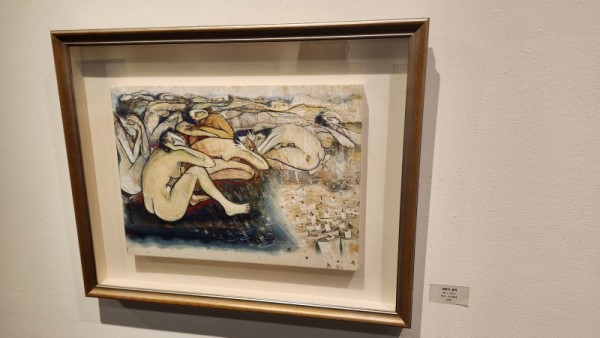
Throughout the interview, Kim emphasized the global competitiveness of Korean sensibilities. She recalled a Norwegian tourist at Gyeonghuigung Palace who was so captivated by her work that they returned to the gallery just before flying home.
Kim defines art as a "simultaneous medium that touches the heart instantly, unlike music or physical education which are bound by time and space." Under the conviction that "the most Korean is the most global," she integrates traditional auspicious symbols—such as the "five virtues of the rooster" and the resilient spirit of barley—into her modern work.
Excerpts from the Artist's Note
"Sumbi-sori is the most sublime song of life on Earth. I believe art restores the vitality of humans exhausted by life and heals invisible scars. In the breath that enters and leaves, I see the birth of cosmic energy.
The waves of Sumbi-sori manifest as red apples, standing in for the tewak buoys that are lifelines. Wounds, sorrows, and pain are crystallized into beauty, becoming apples full of intense life—like a rising sun—creating a new 'oreum' of hope.
I dye and layer colors with every single breath, putting sincerity into the layers of time and space. Through this arduous task, I hope viewers discover a special aesthetic—the 'Aesthetics of Fermented Color'—that breathes soul into the work."