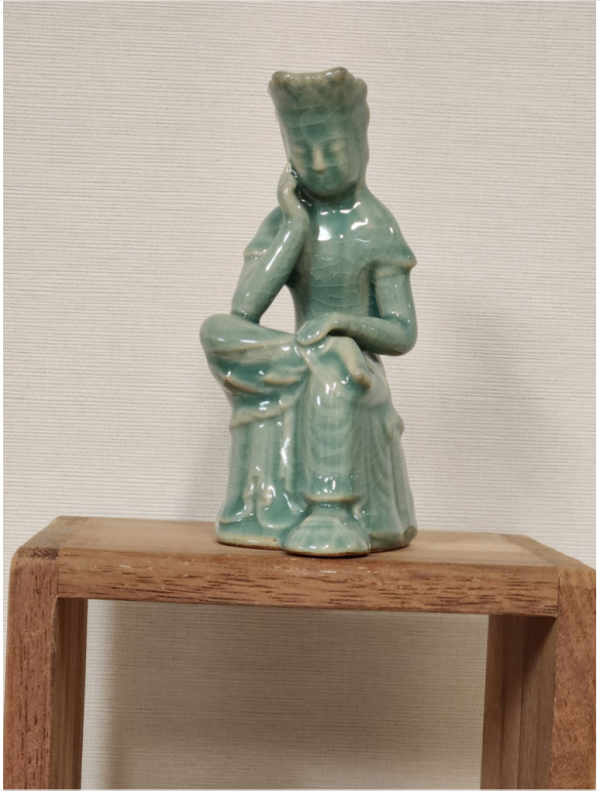
Celadon Bangasayusang (Pensive Bodhisattva) on display at Gallery 5
Price: KRW 40,000
Purchase link:
https://smartstore.naver.com/insadong_gallery5/products/10089463083
In the heart of Insadong, where tradition and commerce uneasily coexist, Gallery 5 (Insadong 5-gil 4 )positions itself as a quiet, non-commercial local gallery grounded in Korean aesthetics.
Located at 4 Insadong 5-gil, Jongno-gu, Gallery 5 is a contemporary art space dedicated to blending the depth of traditional Korean aesthetics with the fluid trends of modern art.
As a complex cultural hub, the gallery showcases a wide spectrum of genres, including painting, crafts, and sculpture, offering visitors a space for artistic reflection rather than a mere exhibition hall.
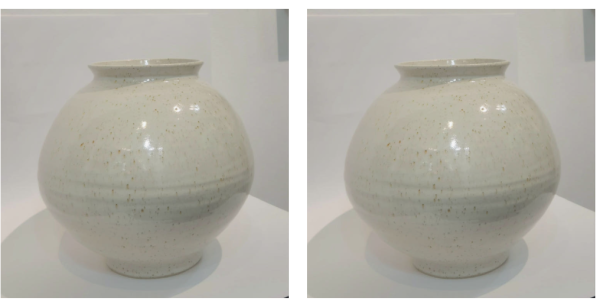
Currently, the gallery radiates a warm, uniquely Korean sensibility, featuring works ranging from minimalist color-field paintings to the iconic Moon Jar interpretations by artists like Choi Young-wook and Lee Sang-pil.
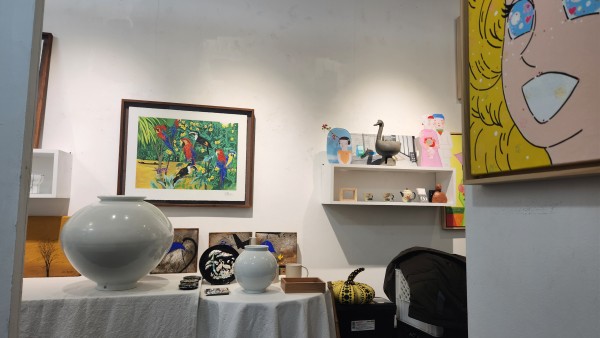
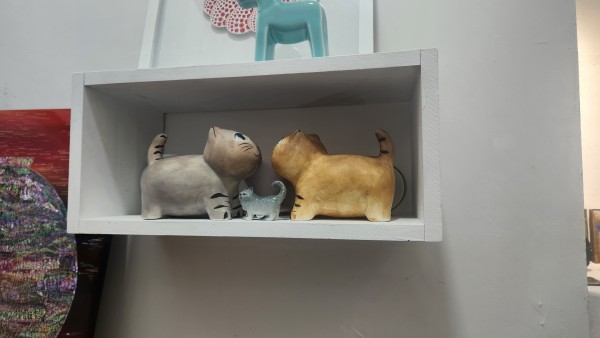
gallery 5 's pictures
Following interior renovations, the gallery is set to host high-profile print exhibitions by masters such as Chun Kyung-ja and Nam June Paik later this year. Space Philosophy: "Emptiness and Focus" The gallery’s design follows a philosophy of minimalism.
While utilizing a "white cube" layout, it incorporates custom display cases and shelves specifically designed for crafts and 3D works to highlight the materiality and narrative of each piece.
The goal is to provide an environment where art can "breathe" naturally, offering a dense, museum-like quality within a modern gallery setting.
Challenges and Aspirations Despite its artistic integrity, Gallery 5 faces the common struggle of small local galleries: balancing traditional beauty with the aggressive commercial trends of the "Art-Tech" market.
While there is a perceived tension between classical Korean beauty and modern commercialism, the gallery remains a vital cultural platform.
It aims to support emerging artists and provide collectors with a trusted aesthetic standard, operating daily from 10:00 AM to 7:00 PM.
While its intention to create a contemplative, community-oriented space is evident, its curatorial direction remains strikingly ambiguous.
Suspended between classical sentiment and contemporary relevance, Gallery 5 appears hesitant to articulate a clear stance within today’s increasingly strategic global art landscape.
This hesitation raises a critical question: can a local gallery survive on atmosphere and sentiment alone, without a firm intellectual or market-facing framework?
Set against this uncertainty, City Gallery, located in Hoehyeon Arcade in central Seoul, presents a sharply contrasting model.
Under the direction of Lee Soo-eon, City Gallery advances a decisive and historically grounded vision of Korean contemporary art, particularly through its rigorous interpretation of Dansaekhwa.
Lee Soo-eon identifies Yun Hyong-keun as the central figure in this movement, emphasizing that Yun’s work does not merely echo Western abstraction but reconfigures it through Korean philosophical restraint.
By blending ultramarine and umber oil paint with turpentine to achieve controlled bleeding effects, Yun transformed Western materials into a medium reminiscent of ink spreading across hanji.
This technique embodied the Confucian values of moderation, emptiness, and moral discipline.
Lee further situates Yun Hyong-keun within a broader historical continuum, connecting him to 18th-century master Jeong Seon (Gyeomjae) and 19th-century calligrapher Kim Jeong-hui (Chusa).
This lineage reframes Dansaekhwa as a contemporary extension of Joseon-era literati aesthetics, rather than a localized variant of Western modernism.
Such intellectual clarity has enabled global recognition. Yun Hyong-keun’s representation by major international galleries such as Gagosian and David Zwirner signals the full integration of Dansaekhwa into the global contemporary canon.
It is no longer perceived as a regional curiosity, but as a coherent philosophical position within art history.
The movement’s contemporary resonance is further demonstrated by its cultural reach.
Yun Hyong-keun’s influence on BTS leader RM, who incorporated the artist’s voice into his album Indigo, illustrates how Dansaekhwa continues to function as a living cultural force, intersecting with global youth culture and soft power narratives.
Viewed through this lens, Gallery 5’s gentle localism appears insufficient.
While its spatial intimacy and non-commercial posture may offer momentary refuge, it lacks the critical assertiveness required to engage meaningfully with today’s art discourse.
City Gallery, by contrast, exemplifies how Korean contemporary art can be both philosophically rigorous and globally strategic without sacrificing its cultural specificity.
In an era when Korean art is increasingly scrutinized on the world stage, clarity is no longer optional.
It is precisely this clarity that separates passive exhibition spaces from institutions capable of shaping art history.