Work GAS-5 SENKICHIRO NASAKA 1958 Mixedmedia on paper 31.0 x 35.0 cm
Whitestone Gallery Ginza Main Gallery is pleased to present Deep into the Blue, a three-artist exhibition featuring Aine Kinashi, Senkichiro Nasaka, and Katsuyoshi Inokuma, focusing on the profound expressive power of the color blue.
The relationship between the Japanese people and blue runs exceptionally deep, tracing back to the sixth century with the arrival of Buddhism and the Medicine Buddha of Lapis Lazuli Light.
Lapis lazuli adorned the treasures of the Shosoin Repository, and the hue ruri-iro was celebrated in classical literature such as The Tale of the Bamboo Cutter and The Tale of Genji.
Through indigo dyeing, the color became woven into the daily lives of Warring States period samurai and Edo period townspeople.
From blue-and-white ceramic patterns to Hokusai’s ukiyo-e woodblock prints, the evolution of this hue into what became globally recognized as "Japan Blue" holds a rich cultural history.
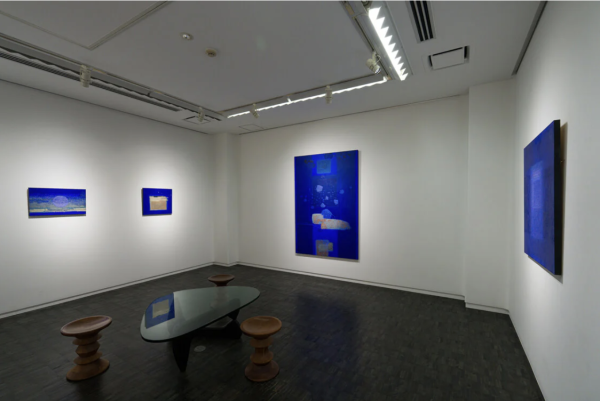
The catalyst that truly refined Japan's delicate color sensibility was the sumptuary laws enacted during the Edo period.
Because flamboyant colors were banned in clothing, ordinary townspeople expanded the subtle variations within permitted indigo, brown, and gray dyes.
This phenomenon birthed the concept of Shiju-hatcha Hyaku-nezumi, or forty-eight shades of brown and one hundred shades of gray, giving rise to the spirit of iki—a refined aesthetic that finds profound sophistication in the slightest variations of shade.
Turning to the exhibition itself, these three masters continue this historical lineage through distinct modern practices.
Aine Kinashi delivers dynamic swells of blue reminiscent of the deep sea, sustained by a continuous rhythmic bass line.
Originally aspiring to be a musician, Aine Kinashi even derived his given name from the German pronunciation of Mozart’s Eine kleine Nachtmusik. While studying at the Osaka School of Music (now the Osaka College of Music), he shifted his focus toward visual art.
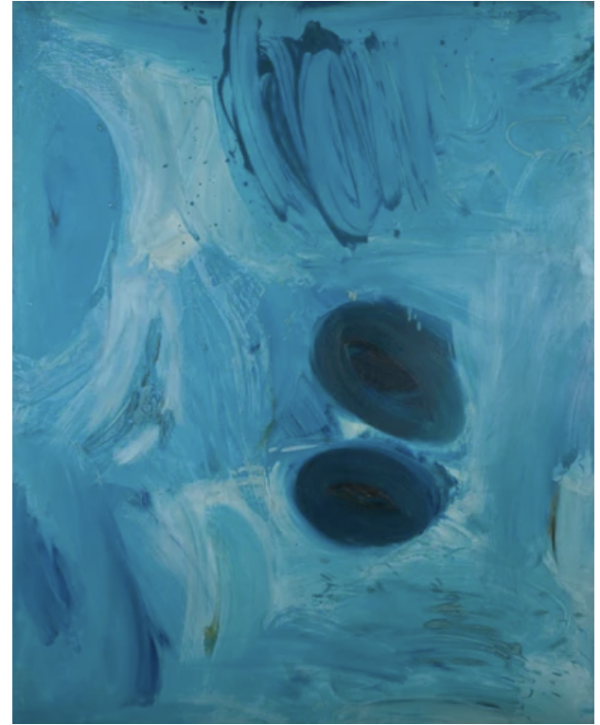
Untitled KA-5 AINE KINASHI 1963 Oil on canvas 162.2 × 130.5cm
In the 1950s, he co-founded the avant-garde art collectives Delta and Tempo alongside artist Masaya Sakamoto, entering the Japanese art scene at a time when Art Informel, Abstract Expressionism, and Anti-Art movements were gaining widespread momentum.
Kinashi is best remembered for his signature series of blue abstract paintings created with oil paint blended with metallic powder.
Applying the medium directly with his fingers, he embedded rhythmic tactile traces across the canvas that resemble a flowing melody, while the deep indigo background functions like a continuous, resonant bassline.
While artists like Wassily Kandinsky sought to translate musical theory into visual forms, Kinashi aimed to embody the physical act of performance itself on canvas, merging music and painting into a tangible new reality.
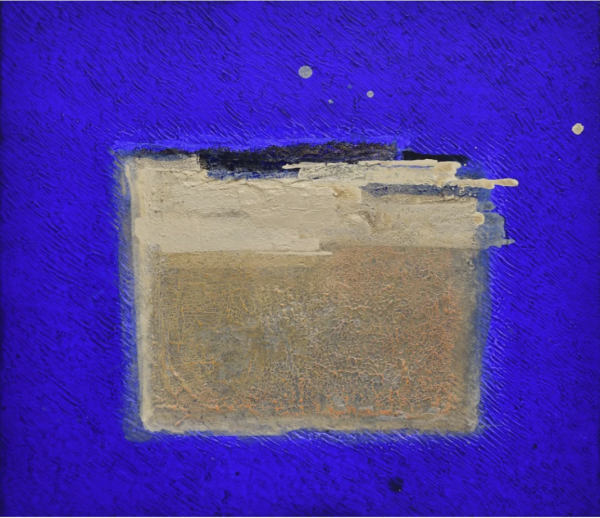
IN BLUE May '22 KATSUYOSHI INOKUMA Acrylic and coffee powder on panel 45.5 × 53.0 cm
Senkichiro Nasaka, who began his career in traditional Japanese painting before turning to Western-style oil painting at age forty, evokes diverse inner landscapes through multi-layered, richly colored textures.
Senkichiro Nasaka studied at several art institutions before attending the Kyoto City University of Arts, where he was a classmate of Kazuo Shiraga.
Though he initially trained in traditional Japanese-style painting (Nihonga), Nasaka transitioned to Western-style oil painting in the 1960s.
In 1965, he showcased his work at the 15th Gutai Art Exhibition and officially joined the pioneering Gutai Art Association.
During his time with Gutai, Nasaka’s practice underwent a major evolution, moving away from Art Informel-inspired painterly compositions toward hard-edge imagery that incorporated kinetic elements and light art—a style that eventually became synonymous with Gutai's broader aesthetic.
For the Guggenheim Museum’s landmark 2013 retrospective, Gutai: Splendid Playground, Nasaka reconstructed an earlier site-specific installation made of aluminum tubing, filling the gallery space like industrial scaffolding.
In recent years, his early Gutai-era works, distinguished by their subtle, multi-layered color blends and rich textures, have seen significant resurgence and high demand among international collectors.
Katsuyoshi Inokuma graduated from high school in Fukushima Prefecture in 1969.
Following formal artistic training at an art academy and institute, he returned to his hometown in 1972.
His decision to pursue a full-time artistic career solidified after winning the Grand Prize at the Memorial of AOKI Nishinippon Art Exhibition in 1996.
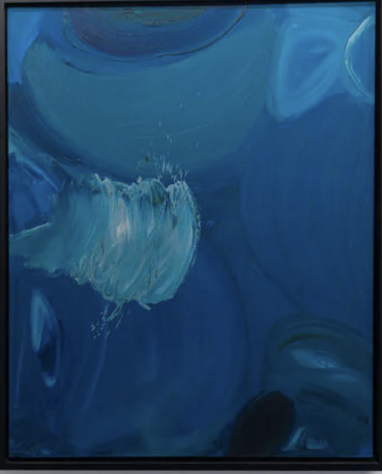
Untitled KA-11 AINE KINASHI 1963 Oil on canvas 162.0 × 131.0 cm
In the 1990s, Inokuma turned his focus toward blue-dominated abstract compositions, launching his signature, ongoing IN BLUE series in 1993.
These works were initially characterized by soft blue partitions interspersed with dotted rectangular motifs.
Over time, his practice evolved away from the vibrant colors, dripping techniques, and decorative elements of his earlier IN BLUE paintings. In his later body of work, Inokuma embraced quiet white and black tones alongside his trademark ultramarine pigment—a distinct shade often referred to as "Inokuma Blue."
To build spatial depth and tactile complexity, Inokuma developed a meticulously layered technique.
He applied a pink underpainting beneath the blue to give the ultramarine a rich, resonant glow.
In selected areas of the underlayer, he mixed in coffee grounds to create an uneven, organic texture that catches the light and adds subtle surface variation across the canvas.
Katsuyoshi Inokuma pursued his unique ultramarine blue to its fullest extent, treating it as the color that resonates most deeply with the human soul.
Visitors are cordially invited to experience this modern iteration of the lineage of blue during the height of summer in Tokyo.