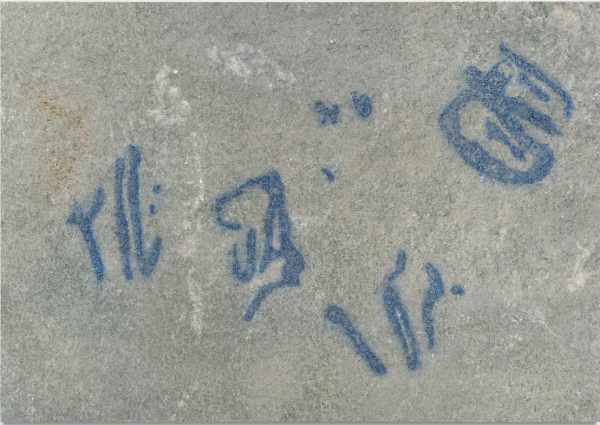
Adjacent Possible, 2021
E. coli bacteria genetically engineered with the DNA from corals and jelly fish to produce vividly colored pigments, mineral pigments on Luserna stone
27 1/2 x 39 3/8 in. (70 x 100 cm)
Marian Goodman Gallery is thrilled to host Recursion, the second solo exhibition by Agnieszka Kurant, running from 6 February to 21 March 2026.
This ambitious showcase presents a series of "speculative thought experiments"—works born from Kurant’s deep collaboration with an interdisciplinary circle of scientists, philosophers, engineers, and linguists.
At the heart of Kurant’s practice is an obsession with how "life" emerges from the many.
Whether studying termite mounds, social movements, or AI algorithms, she explores collective and non-human intelligence. Her work pulls back the curtain on "digital capitalism," revealing how our online interactions are harvested as raw data to feed vast, recursive machines.
In Kurant’s world, the boundary between the biological and the digital dissolves; her sculptures and installations behave like living organisms—unstable, hybrid, and in a constant state of becoming.
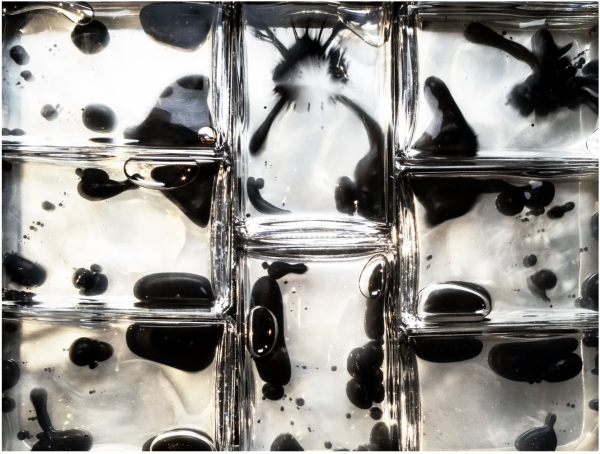 Alien Internet 2, 2023/2026
Ferrofluid, electromagnets, glass, sensors, Arduino, artificial intelligence, custom programming
10 x 13 x 6 in. (25.4 x 33 x 15.2 cm)
Highlights of the Exhibition
Greeting visitors at the gallery window, Future (Invention) translates the word "future" into fourteen languages.
It challenges Western linear time by highlighting cultures—like the Aymara or Māori—who perceive the future as existing behind or above us, rather than ahead. Moving into the center of the space, Uncomputables and Unthoughtforms utilize "chemical computers" to grow metal crystals in an aquarium.
These structures are controlled by AI that processes real-world socio-political data, turning shifting global events into "crystallized ideas" that have not yet been thought by humans.
In the work Recursivity, a bronze chameleon coated in liquid crystals reacts to a custom AI system.
This system monitors millions of social media users speculating about the future, translating their collective anxiety or hope into thermal signals that alter the sculpture’s color in real-time. Similarly, Alien Internet features a shape-shifting organism made of magnetic ferrofluid animated by the migration data of wild animals, reimagining the natural world as a sentient, planetary communication network.
Kurant also explores deep time in Adjacent Possible, where she uses AI to "continue" the evolution of Paleolithic cave art. These new symbols are etched into stone using pigments made from genetically engineered bacteria.
In the film Phantomatics, she presents AI-generated languages that have no human speakers, exploring the "uncanny" nature of machines learning to communicate without the context of human culture.
This investigation into value concludes with Sentimentite, a literal new mineral created by grinding up historical currencies—from shells to e-waste—and shaping them based on "sentiment analysis" of global social media posts.
The Preverbal Frontier: Wordoid
The exhibition concludes with Wordoid, a holographic film developed with neuroscientists.
Using "hyperscanning" to record simultaneous brain activity, the work bypasses language entirely.
It transforms raw neural signals—pain, joy, and sensation—into shifting 3D forms, allowing viewers to witness a "wordless conversation" and a new form of collective consciousness.
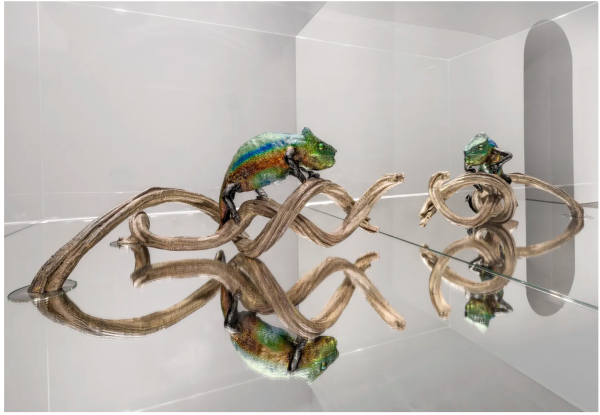
Bronze, museum glass, liquid crystal pigments, heat sinks, Peltier elements, artificial intelligence, custom software, computer, AC, custom pedestal
33 7/8 x 29 1/2 x 51 1/8 in. (86 x 75 x 130 cm)
The exhibition is accompanied by the monograph Agnieszka Kurant: Collective Intelligence (Sternberg Press, 2025).
Kurant’s work is currently being exhibited globally, with concurrent shows at the MCA Sydney and the Louisiana Museum of Modern Art.
Her visionary practice continues to bridge the gap between art and science, asking what it means to be human in an age of automated prediction.
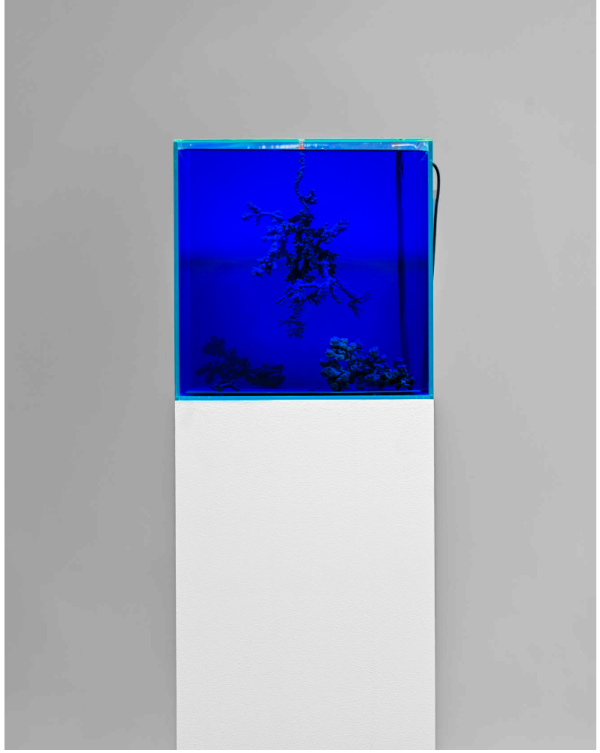
Uncomputables, 2026
Aquarium, copper sulphate, sulfuric acid, distilled water, copper anode, copper electrodes, wires, acrylic, electroplating rectifier, wifi-enabled microcontroller, relay module
11 3/4 x 11 3/4 x 11 3/4 in. (30 x 30 x 30 cm)