Mimesis Art Museum (253 Munbal-ro, Paju-si, Gyeonggi-do) presents its special 2026 exhibition, SYMBOLIC, running from 29 July through 1 November 2026. Derived from the ancient Greek symbolon—a token formed by splitting an object into two pieces to be reunited later for mutual identification—a symbol is historically grounded not in absolute, self-contained truth, but in an incomplete promise requiring separated fragments to meet once more.
Focusing on the imperfect reality of the adjectival state of being "symbolic" rather than the static finality of the noun "symbol," this exhibition features artists Sejin Hong, Sujung Jung, and Juna Lee.
Each artist explores the inherent impossibility of fully reproducing reality, employing and reconstructing symbolic forms through distinct visual languages.
Visualizing Sensory Flaws and Digital Interfaces: Sejin Hong
Sejin Hong investigates mediated perception and sensory shifts, drawing from her personal experiences with hearing aids and cochlear implants.
Her early works, such as Things in Front of Eye (2017) and Stadium (2018), examined the interactions between systemic computation and organic structures through fractal plant patterns and cellular forms.
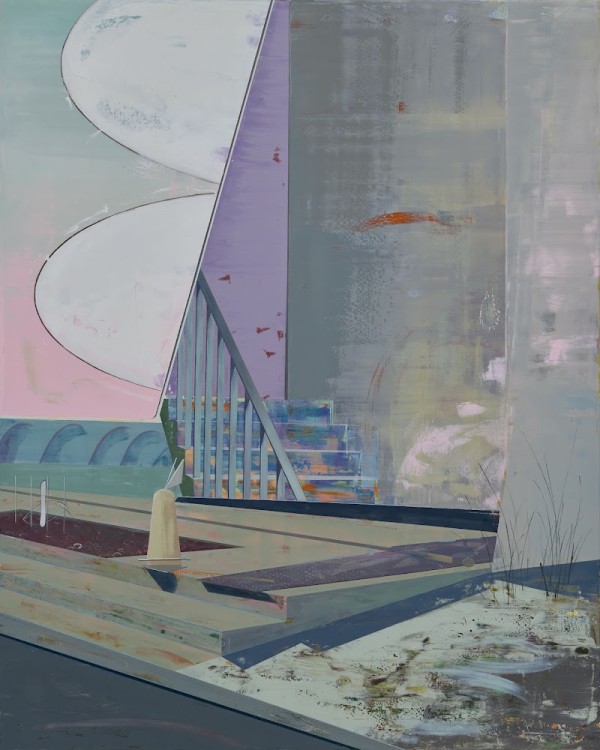
Her practice evolved into compositions defined by flattened, segmented planes and lines, where everyday scenes undergo overlap and division reminiscent of digital image processing.
By pushing, scraping, and masking thick paint on canvas, Hong renders visible the material noise, signal loss, and transmission errors inherent in technological mediation.
In Wave of Triangle (2024), repeating triangular plates create a surface that is simultaneously continuous and fragmented, coexisting alongside flattened backgrounds to reflect how devices like cochlear implants selectively filter sensory input.
Next, and Next (2025) uses circular arrangements of pillars to introduce sequential movement into a static plane, evoking digital sampling where subtle gaps emerge between discrete time units.
Hong’s geometric planes and layered shapes refrain from explicit definition, asking viewers to re-examine how perception is structured and operated.
Unmasking Instincts and Subverting Classical Iconography: Sujung Jung
Sujung Jung injects tension into traditional art historical motifs, mythic figures, and pop-cultural animation tropes.
Through delicate, meticulous rendering, Jung exposes the raw, untamed human instincts and collective drives hidden beneath bright, fairy-tale aesthetics.
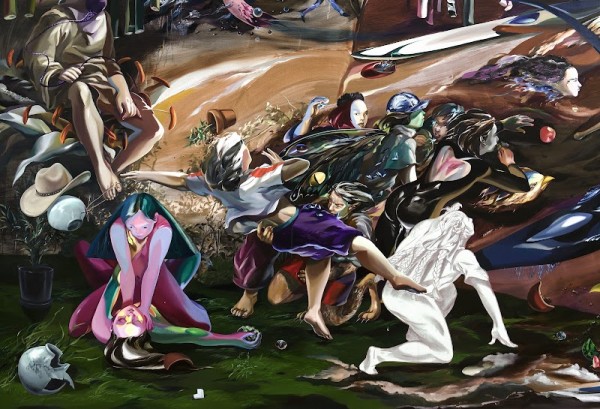
In Swooping (2025) and Surging (2025), massed swarms of birds and rodents sweep across large canvases, reflecting the blind, irrational momentum of contemporary group behavior. Works such as When the Night Begins (2025) present shimmering clusters reminiscent of fine jewels or fruit, which reveal themselves upon closer inspection to be unsettling egg masses—serving as metaphors for primal fertility and sexuality.
Jung destabilizes sensory expectations by pairing classical structures with subversive reversals. In Red Sunset and the Born (2018) and Oasis (2019), she strips away conventional eroticism by presenting flattened, unadorned nude nymphs.
In Lava (2025), she adapts 17th-century Northern European still-life conventions, replacing hunted game with human heads to highlight the cruel duality of human desire while suspending moral judgment.
This thematic inquiry extends into her recent tronie portraits, where anonymous, unidentifiable faces function as vessels for unrefined emotion and subconscious impulses, bringing suppressed realities to the fore.
Reclaiming Aura from Contaminated Icons: Juna Lee
Juna Lee investigates human madness and the ritualistic accumulation of imagery, sourcing icons from books and digital media that have been stripped of their original contexts.
Her obsession with madness is rooted in personal history—specifically her father's lifelong struggle with mental illness following torture during South Korea's democratization movement.
For Lee, layering collected symbols across the canvas serves as an act of mourning and understanding, connecting personal trauma to universal human patterns.
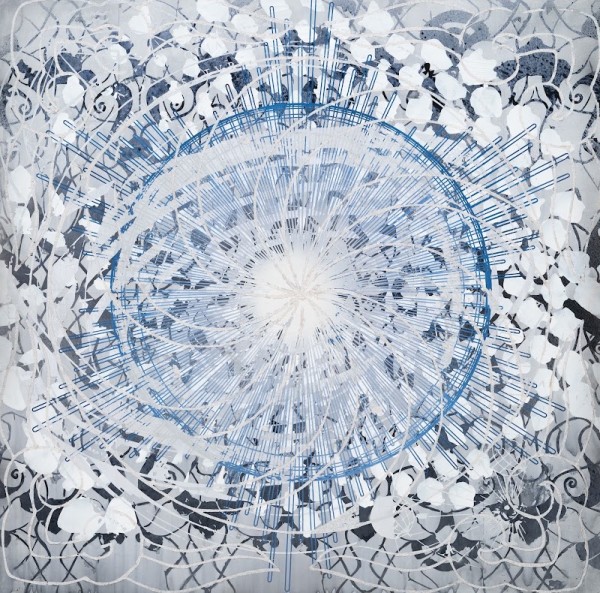
Lee’s structural foundations combine procedural painting experiments—such as Verse (2018) and Station (2018)—with optical art and mathematical geometric progressions explored in her Fractal Study (2020) series.
Selecting sacred symbols that have been degraded or commercialized through mass consumption, such as hearts, crosses, and snakes, Lee converts digital designs into physical stencils.
She applies thick layers of paint through a stencil technique, peeling and scraping the material to leave behind heavily textured, skin-like layers that embody physical time.
As these symbolic layers accumulate, the underlying shapes blur into an illegible palimpsest, transforming discarded icons into an overwhelming, ceremonial presence that reclaims a visceral aura through physical imperfection.