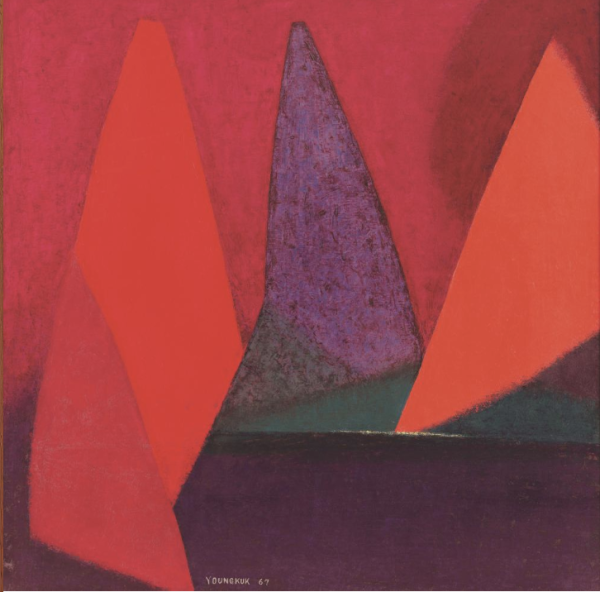
Yoo Youngkuk’s 〈Work〉 (1967)
In the spring of 1964, at forty-eight years old, the foundational pioneer of Korean abstraction Yoo Youngkuk staged his long-awaited debut solo exhibition.
For an artist who had served for decades as the driving operational core of the Korean avant-garde—spearheading seminal collectives such as Neo-Realism, the Modern Art Association, and the Contemporary Artists Exhibition—this public entry was remarkably belated.
The debut featured fifteen monumental, high-octane canvases that immediately electrified a postwar art scene still grappling with political trauma.
Renowned critic Kim Young-ju famously celebrated Yoo as an investigative artisan of color, marveling at his intense, dynamic structuring of primary reds, yellows, greens, and blues that pulsated across works scale-rated well over a hundred ho.
Yet, the exhibition's true seismic impact lay in Yoo's quiet, uncompromising philosophical break from his contemporaries.
While celebrated peers like Han Mook, Moon Shin, and Kim Whanki sought artistic sanctuary abroad in Paris and New York, Yoo turned inward.
He abandoned group art circles entirely, pledging to engage with the public solely through solo exhibitions every two years.
Retreating to his studio, Yoo turned away from the accelerating tempo of Korea's industrial economic engine, embracing a rigorous, monastic routine of daily studio work to explore the absolute depths of geometric abstraction.
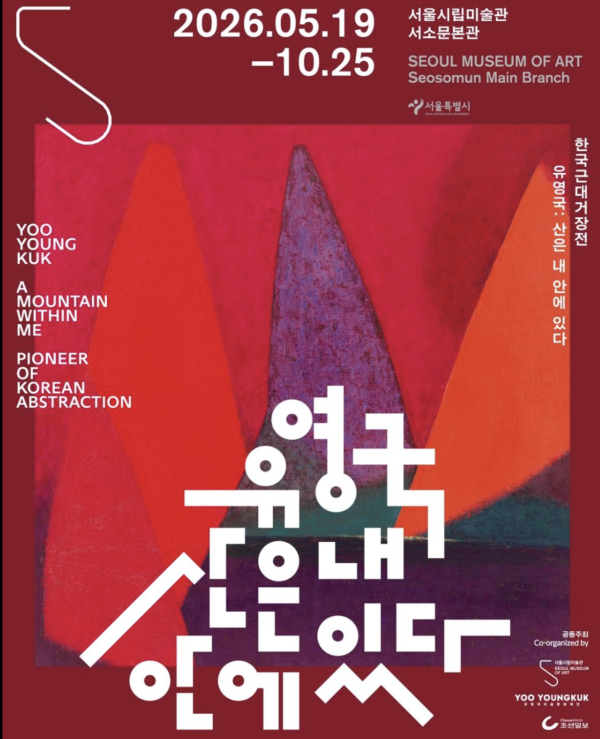
To honor the 110th anniversary of this modern master, the Seoul Museum of Art (Seosomun Main Building), in an unprecedented partnership with the Yoo Youngkuk Art and Culture Foundation and the Chosun Ilbo, presents Yoo Youngkuk: The Mountain is Within Me.
Running from May 19 to October 25, 2026, this historic retrospective stands as the largest showcase of Yoo’s legacy, bringing together over 170 works, including previously unreleased canvases, physical reliefs, vintage photographs, raw drawings, and extensive archival material.
Launching the museum's new Masters of Modern Korean Art exhibition series, the project re-evaluates Yoo’s mid-century aesthetic triumphs through a contemporary lens.
artist Yoo’s life was defined by creative resilience, maintaining his avant-garde integrity while living through the Japanese colonial occupation, the Korean War, and decades of rapid, hyper-industrialization.
Breaking free from traditional, strictly linear historical presentation, the exhibition charts an innovative temporal course.
It anchors the viewer in the critical watershed year of 1964, winding backward through his early experimental roots before sweeping forward into the luminous, spiritual abstractions of his final decades.
This fluid structure allows the foundational building blocks of his painterly lexicon—point, line, plane, and pure pigment—to emerge with exceptional dimensional clarity.
Navigating Yoo's oeuvre requires entering the structural spirit of the mountain itself.
Far from a literal depiction of the terrain surrounding his native home in Uljin, the recurring mountain form serves as a profound psychological container, capturing memories of local heritage, historical displacement, and a refined interior balance constructed from line and color.
For Yoo, the mountain was never an object to be copied from nature, but rather a plastic truth and an internal composition of the mind.
The exhibition traces this conceptual development back to its genesis in 1935 at Tokyo’s liberal Bunka Gakuin, where a young Yoo eagerly absorbed the utopian philosophies of Cubism, Futurism, Surrealism, and Russian Constructivism.
Following his return to Korea in 1943 amid fracturing geopolitical borders, he faced a decade of intense professional displacement, during which he operated fishing boats and ran a family brewery to provide for his dependents during the devastation of the war.
Despite this self-described lost decade away from the easel and a subsequent clash with the academic conservatism of the official National Art Exhibition, Yoo’s commitment to abstraction remained unyielding.
He continually revitalized his work, shifting freely from Constructivist reduction to pastoral semi-abstraction and passionate Expressionism, ensuring his art remained a vital, evolving force.
Yoo Youngkuk’s tactile, layered surfaces refuse to settle into passive history, instead offering a striking existential anchor to a contemporary digital society increasingly mediated by automated algorithms and artificial intelligence.
In an era where the act of creation is continually redefined by technology, Yoo’s calculated, physical canvases pull the viewer back to the raw, human necessity of artistic making.
The transcendent spaces captured in his late-career output reveal a profound infinity, proving that the ancient language of oil paint retains an unparalleled capacity to manifest the secular sublime.
Complete with a bilingual audio guide narrated by the internationally acclaimed pianist Son Yeol-eum in Korean and Peter Bint in English, this admission-free retrospective is proudly supported by principal sponsors Bulgari, Shinyoung Securities, Hansol Paper, and Samhwa Paints.
Much like the deep, immovable peaks he spent his lifetime translating onto canvas, Yoo’s masterpieces endure with an unshakeable vitality, quietly guiding a modern audience in search of their own interior landscapes.
Yoo Youngkuk’s 〈Work〉 (1967) serves as a profound interrogation into the limits and expansion of twentieth-century geometric abstraction.
Following his watershed 1964 solo exhibition, Yoo channeled his creative energy entirely into refining his visual vocabulary, leading directly into what art historians regard as the absolute zenith of his career during the late 1960s and 1970s.
This period of intense productivity was fueled by his radical decision to resign from his professorship at Hongik University, a position he held from 1966 to 1970, driven by a desire to free himself from institutional constraints.
He replaced academic life with a rigorous, self-imposed daily ritual—locking himself in his studio from nine in the morning until six in the evening—transforming his everyday existence into a monastic pursuit of pure form.
The painterly architecture of this era is characterized by an unyielding structural order, where lines, flat planes, and high-octane pigments engage in a brilliant dance of balance and confrontation.
The late 1960s was a period marked by global leaps in science and technology, highlighted by the Apollo moon landing and mirrored domestically by South Korea's rapid economic modernization.
These societal shifts naturally synchronized with international art movements like Op art and Hard-edge abstraction, sparking a widespread fascination with geometric abstraction across the Korean art scene.
While Yoo operated in harmony with these shifting cultural tides, his canvases remained anchored to a deeply personal, interior necessity rather than superficial trends.
In 〈Work〉 (1967), this evolution manifests as a sophisticated harmony of balanced geometries, intense color interactions, and a subtle yet distinct engagement with the physical texture of oil paint.
Moving beyond a simple reliance on the primary triad of red, yellow, and blue, Yoo introduced brilliant, daring variations of purple, pink, and deep green.
These audacious color fields push against one another with architectural precision, offering viewers an experience of absolute painterly beauty.
Remarkably, despite the immense historical and aesthetic weight of the masterpieces produced during this golden era, it was not until 1975, when the artist reached the age of fifty-nine, that Yoo Youngkuk sold his very first painting—a poignant testament to a master who pursued the sublime landscape of his inner mind entirely insulated from commercial validation.
Yoo Youngkuk famously declared that he would dedicate his life to studying the absolute basics of painting until the age of sixty.
By the late 1970s, having crossed that self-imposed conceptual milestone, the master reached the true twilight of his career, entering a mature and serene realm of simsang (심상)—the abstraction of the inner mind, where the soul and the natural world exist in perfect harmony.
Yet, this hard-won artistic tranquility was immediately tested by profound physical adversity.
In 1977, Yoo underwent a major surgery to implant a cardiac pacemaker, marking the beginning of a grueling medical battle that would include eight major surgeries and thirty-seven hospitalizations before the end of his life.
Despite his deteriorating health, Yoo steadfastly refused to lay down his brush. Instead, he maintained his unwavering devotion to the canvas, continuing his rigorous daily ritual of "commuting" to his home studio from nine in the morning until six in the evening.
Working entirely alone without a single studio assistant, Yoo directly confronted the raw physical materiality of the canvas, continuously questioning and testing the absolute essence of abstraction through the motion of his own hands.
His legacy is not the romanticized myth of a tragic, short-lived genius, but rather a solemn, deeply moving epic of human endurance—a master who carried the immense weight of mortality without ever permitting his creative engine to stall.
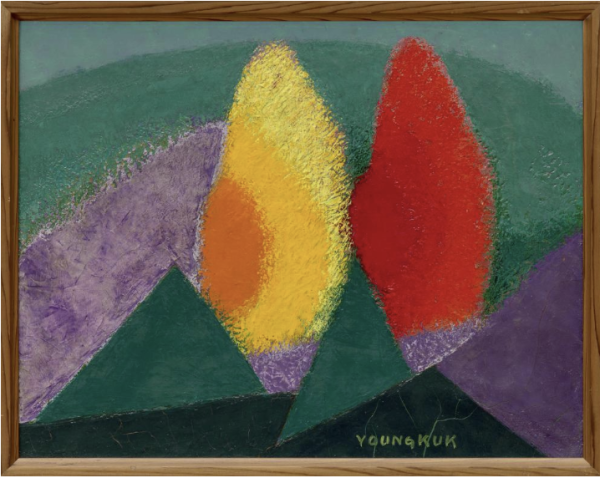
Yoo Youngkuk’s 〈Work〉 (1977)
In 〈Work〉 (1977), this profound personal evolution manifests as a lyrical, meditative landscape where the historical tension of his hard-edged geometry dissolves into a softer, poetic quietude.
The mountains and horizons are no longer external objects of observation, but internal spaces where stillness and existential gravity peacefully coexist.
Much like the universal journey of ascending and descending a physical mountain, the rhythmic variations of color and form in this late masterpiece do not ask the viewer to stand as a detached observer.
Instead, the canvas invites us to step into the composition as active companions, quietly walking alongside the master on his long, serene descent home.
Situated in the historic heart of Jeong-dong, an area imbued with the diverse cultural layers of Seoul’s modern and contemporary history, the Seosomun Main Building of the Seoul Museum of Art presents a striking architectural dialogue where the historic Renaissance-style facade of the former Supreme Court seamlessly integrates with bold, modern structural design.
To welcome a diverse public, this inclusive institution opens its doors from Tuesday through Thursday from 10:00 AM to 8:00 PM, and generously extends its hours every Friday until 9:00 PM to foster a vibrant late-night cultural atmosphere.
During weekends and public holidays, the museum tailors its schedule to the natural cycles of the year, welcoming visitors from 10:00 AM to 7:00 PM during the warm summer season spanning March to October, and adjusting to a 6:00 PM closing time during the winter months from November to February.
While the museum strictly observes closures on New Year’s Day and every Monday, it remains dynamically responsive to the civic calendar by operating normally should a public holiday happen to fall on a Monday.
To ensure an unhurried and immersive aesthetic experience, final admission is strictly permitted up to one hour prior to closing time, allowing patrons to comfortably navigate the galleries where general admission remains entirely free of charge, though select special ticketed exhibitions may require a separate fee.
Located at 61 Deoksugung-gil, Jung-gu, Seoul (Postal Code 04515) and reachable via its central helpline at 02-2124-8800, the institution functions as a fluid communal crossroads where all individuals can intimately encounter and experiment with art.
The museum’s expansive curatorial vision reaches far beyond conventional gallery walls, activating its spaces through a continuous matrix of contemporary exhibitions, educational initiatives, independent screenings, creative workshops, live performances, and critical artist talks.
This multi-layered programming operates in harmony with specialized lifestyle spaces, including the curated SeMA Cafe+, an independent art bookstore, welcoming communal lobbies, and an expansive outdoor sculpture park, altogether weaving an accessible, enriching pathway toward multifaceted artistic discovery for the global populace.
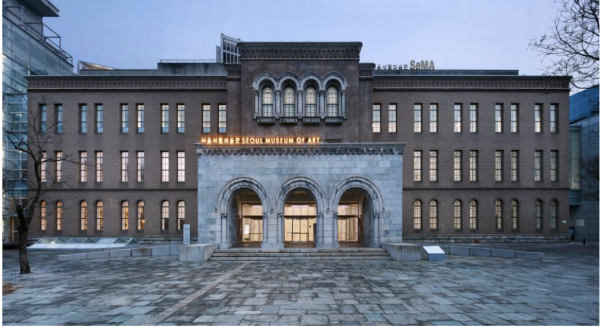
Seoul Museum of Art (Seosomun Main Building)